States Where Skilled Trades Are Aging Out the Fastest
Trade Industry Insights / States Where Skilled Trades Are Aging Out the Fastest
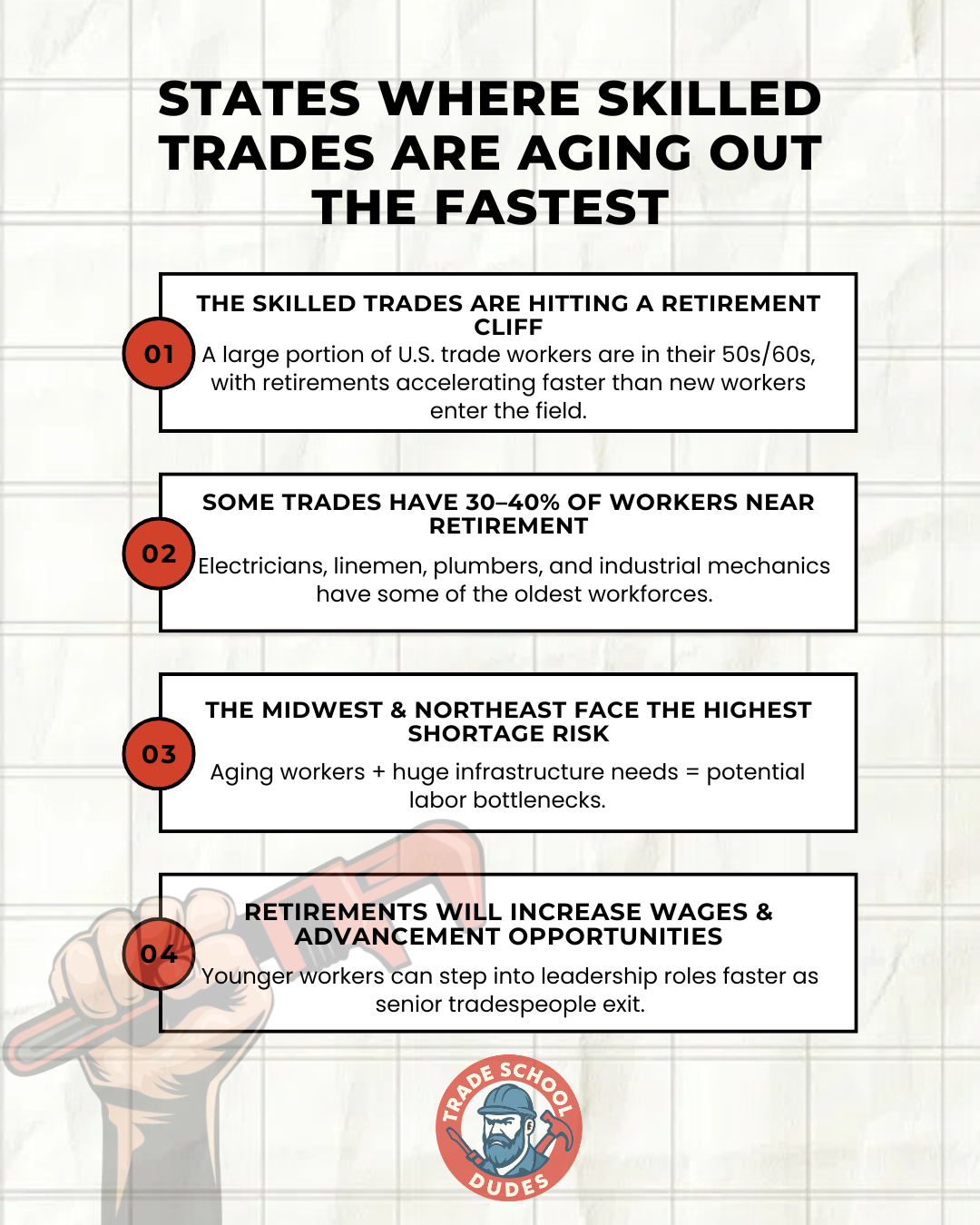
Across the U.S., many skilled trades are hitting a critical turning point: a large share of the workforce is in their 50s and 60s, and retirements are beginning to outpace new workers entering the field. For states that depend on electricians, welders, linemen, heavy equipment operators, and industrial mechanics, this “retirement cliff” could translate into project delays, higher labor costs, and unfilled jobs.
This overview looks at which trades are aging out the fastest and which states are most exposed to looming shortages, based on average worker age and the share of workers approaching retirement age.
1. Trades with the Oldest Workforces
Some trade occupations have significantly older age profiles than others. The table below highlights a set of high-impact trades, their typical age distribution, and how exposed they are to retirement risk.
| Trade | Average Worker Age (Approx.) | % of Workforce 55+ (Approx.) | Retirement Risk (2025–2035) | Career Guide |
|---|---|---|---|---|
| Electricians | Mid–40s | 25–30% | High – Many senior electricians managing complex systems near retirement. | How to Become an Electrician |
| Plumbers & Pipefitters | Mid–40s | 25–35% | High – Aging workforce in commercial and industrial plumbing. | How to Become a Plumber |
| Industrial Maintenance & Mechanics | Upper–40s | 30–35% | High – Many “fix-anything” veterans nearing retirement in factories and plants. | How to Work in Industrial Maintenance |
| Lineman / Powerline Technicians | Upper–40s | 30–40% | High – Utilities facing simultaneous grid upgrades and retirements. | How to Become a Lineman |
| Heavy Equipment Operators | Mid–40s | 25–30% | High – Large cohort of long-tenured operators on big civil projects. | How to Become a Heavy Equipment Operator |
| Diesel Mechanics | Early–40s | 20–25% | Moderate–High – Strong demand plus slower inflow of new techs in some regions. | How to Become a Diesel Mechanic |
| Welders | Early–40s | 20–25% | Moderate–High – Aging specialists in structural steel, shipbuilding, and heavy industry. | How to Become a Welder |
| Carpenters | Early–40s | 18–22% | Moderate – Retirements plus strong demand in housing and commercial builds. | How to Become a Carpenter |
| Masonry | Mid–40s | 25–30% | High – Skilled brickmasons and block masons aging out in many states. | How to Become a Mason |
| Sheet Metal Workers | Mid–40s | 25–30% | High – Complex commercial systems rely on mid- to late-career experts. | How to Work in Sheet Metal |
For many of these trades, retirements don’t just remove headcount — they take decades of troubleshooting, mentoring, and jobsite leadership with them.
2. States Where Skilled Trades Are Aging Out the Fastest
Some states have a double challenge: older-than-average trade workers and strong demand from construction, manufacturing, or energy projects. That combination makes future shortages more likely.
The table below provides a directional look at states that are especially exposed to aging-out risk in the trades.
| State / Region | Key Trades with Older Workforces | Retirement Risk | Why This State Is Vulnerable |
|---|---|---|---|
| Midwestern Manufacturing States (OH, MI, IN, IL) | Industrial mechanics, electricians, welders, machinists. | Very High | Legacy manufacturing hubs with long-tenured workers in plants and refineries, plus new investment in EV, battery, and advanced manufacturing. |
| Northeast & Mid-Atlantic (PA, NY, NJ, MA) | Electricians, plumbers, HVAC, linemen. | High | Aging infrastructure, older unionized workforces, and major utility, transit, and building upgrades converging over the next decade. |
| Upper Midwest & Great Plains (MN, WI, IA, ND, SD) | Welders, heavy equipment operators, linemen, industrial techs. | High | Strong dependence on construction, energy, and agriculture with smaller populations to replace retiring workers. |
| Pacific Northwest (WA, OR) | Electricians, industrial maintenance, carpenters. | High | Port, tech, and manufacturing growth push demand up while many senior tradespeople head toward retirement. |
| Rural & Small-Town States | Multi-trade generalists (electrician/plumber/maintenance), linemen, diesel mechanics. | High | In smaller communities, one or two senior tradespeople often cover an entire region. When they retire, there may be no local replacement. |
| Sunbelt Growth States (TX, FL, AZ, GA, NC) | Electricians, HVAC, plumbers, equipment operators. | Moderate–High | Massive population and construction growth mean even “younger” workforces can’t keep up with demand if retirements accelerate. |
Data Sources & Methodology
Age estimates and retirement exposure levels in this report are derived from a combination of U.S. Bureau of Labor Statistics Occupational Employment & Wage Statistics (OEWS), state workforce dashboards, Census workforce microdata, and union apprenticeship and age distribution surveys. Values shown represent directional estimates rather than exact counts due to variations in reporting by state and occupation. Trades were evaluated based on average worker age, the share of workers aged 55+, and projected industry growth from 2025–2035. State-level risk scores reflect combined factors including workforce age, local training capacity, project pipelines, and known labor shortages.
States with big infrastructure pipelines, strong manufacturing bases, or rapid population growth have the most to lose if they can’t replace aging trade workers fast enough.
3. Where Retirements Could Turn into Critical Shortages
The most serious risk comes when an aging workforce overlaps with:
- Large, multi-year infrastructure or industrial projects
- Limited local training capacity or few accredited trade schools
- High housing costs that make it hard to attract younger workers
- Rural regions where one or two employers dominate the local labor market
Here are a few examples of “critical shortage” scenarios that states and regions are watching closely:
- Grid upgrades + older linemen: Utilities in many states are planning major grid modernization and storm-hardening projects just as their most experienced linemen are approaching retirement.
- Industrial expansions + senior maintenance techs: New manufacturing plants and refineries need industrial maintenance techs, but many of the current experts in these roles are late-career workers.
- Water systems + aging operators: Smaller cities and towns rely on a handful of experienced operators and maintenance workers to run water and wastewater plants. When those workers retire, there may be no bench behind them.
4. What This Means for Future Trade Workers
For students, career changers, and apprentices, an aging workforce is not just a challenge — it’s an opportunity.
- Faster advancement: Younger workers in the trades may move into lead roles more quickly as senior workers retire.
- Stronger bargaining power: Persistent shortages can support better wages, benefits, and working conditions in high-demand trades.
- Employer-funded training: Companies and unions are more likely to invest in training, apprenticeships, and upskilling to rebuild their pipeline.
If you’re considering a trade, pay close attention to:
- Which trades in your state have older-than-average workforces.
- Whether your state has big upcoming infrastructure, energy, or manufacturing projects.
- How many accredited trade schools, apprenticeships, and employer training programs exist in your region.
An ideal strategy is to enter a trade where:
- Demand is driven by long-term projects (infrastructure, utilities, manufacturing), and
- The existing workforce is older, with many planned retirements over the next 5–10 years.
Use this analysis as a starting point, then explore state-by-state trade school guides, verified apprenticeships, and detailed career paths to find the places where aging workforces and strong project pipelines line up in your favor.
